Sunday, July 10, 2016

Last LETTERS HOME

Andrew Allard's letter was written Feb 11, 1777, REVELATIONAL WAR
February 11, 1777
Loving Wife,
My regards to you and our children, hoping
These few lines will find you all in good
Health as through the goodness of God...
As for news, I have nothing strange to
Inform you at present, only that I went
Out as a scout one day this week, along with
Lt. Willson, eleven more, and we all
Had a chance to come across the Light
Horse. I am a little distance from the
The rest of our men had liked to have been
Taken by them, but through the goodness
Of God, I got to the rest of our party and
We made a stand, and we kept them back
None hurt upon our side. We lie in four
Miles, of the Hessian lines, and we use
They go every other day. My love to all my
Friends, so I remain your loving Andrew Allard.
Andrew Allard

d. August 23, 1777 
Sullivan Ballou wrote on July 14, 1861, about CIVIL WAR.

He served as a Major in the 2nd Rhode Island Volunteer Infantry. On July 14, 1861, Ballou wrote an eloquent letter to his wife predicting his death. He was wounded at the First Battle of Bull Run on July 21 and died from his injuries a week later. His sentiments in the letter became famous and were quoted in Ken Burns' "Civil War" documentary. 

July 14, 1861
My Dear Wife,
The indications are very strong that we shall move in a few days, perhaps tomorrow, and lest I should not be able to write you again, I feel impelled to write a few lines that may fall under your eye when I am no more...I have no misgivings about or lack of confidence in the cause in which I amen gaged, and my courage does not halt or falter... Sarah, my love for you is deathless. It seems to bind me with mighty cables that nothing but Omnipotence can break, and yet my love of country comes over me like a strong wind and bears me irresistibly with all those chains to the battlefield. The memories of all the blissful moments I have enjoyed with you come crowding over me, and I feel most deeply grateful to God and you that I have enjoyed them for so long... If I do not return, my dear Sarah, never forget how much I loved you...

Sullivan Ballou
July 21, 1861
Robert A. Baun wrote on April 3, 1943, about WWII.
April 3, 1943 
... A guy gets in some serious 
thinking out here... Sometimes when I 
happen to be walking along alone, say for 
 instance at night, I stop and say, "Well,
Bob, you are in a heck of a fix. What are
you doing here? Do you remember how 
you laughed at the idea of ever bearing
arms...? It's the fellows that have gone
before us who make us willingly bear
our burdens. Dear God, spare our lives.
For we are young and love life so much.
This is just a short incident in a fellow's 
life, I tell myself, and soon it will be
behind me, and I will have forgotten it,
and settle down among you all again.
....This is one game I'm going to beat,
I know. When I played baseball, I never
wanted to sit on the bench; always
wanted to play the whole game. And here
too, I'm going out every time, and while
too, I
I'm playing this game, I'm going to play
hard, and win.
Robert A. Baun d. April 1943
Bertram Arnold Bunting letter written Jan 17, 1968


BERTRAM ARNOLD BUNTING MAJ - O4 - Army - Regular 20th Eng Bde Length of service 10 years tour began on Jul 9, 1967. Casualty was on Feb 12, 1968, in SOUTH VIETNAM, Hostile, died of wounds, GROUND CASUALTY GUN, SMALL ARMS FIRE. Body was recovered Panel 39E - Line 2
January 17, 1968
My darling wife-
As this day draws to a close, I can only
think of you. Possibly, I'm just emerging from
the R&R haze in which I've been enveloped for 
these past weeks. Until now, the details of our
The meeting was all so clear: I could still hear your 
Your absence is upon me; I know all too well
This feeling: I lived with it for many months
before December. My only hope is that I can
survive this attack of my imagination upon my
sanity.
When we meet again,n I can promise you that
there will be no wasted moments. Every minute
spent with you will be nothing less than a gift
to be cherished. I have found that it isn't
necessary to always do: talking, 
eating, walking, dancing, and swimming. 
There are many
times when I want only to know your presence:
to hear you moving around, to see you next to 
me. There are many ways of living, perhaps. 
The simplest is the most satisfying.
Bertram Arnold Bunting
d. February 12, 1968
John Chilto's letter, written in 1777
John Chilton was Captain of the Third Virginia Infantry Regiment in the Revolutionary War. He was mortally wounded in 1777 at the Battle of Brandywine, but refused to be carried off the field until the battle was over so as not to discourage his men.

My dear Friends, 
....We are on our guard and our men seem resolutely bent to give them a warm reception at the meeting... There were three ships and a tender lying opposite the enemy's camp about a mile below our lowest lines; within these two days, two more and a tender have joined them. What or when we shall be ever ready to receive their attacks as men fighting for Liberty should do...
.... We had between 50 and 100 killed and wounded; the enemy about 300... On one side of the field of battle is a steep, rocky precipice, where we imagine they threw many of their dead, as the buzzards and ravens Resort to that place constantly. 
.... I begin to think that mankind, when engaged in warfare, are as wary and timorous of each other as deer are of men, and the boldness of one party increases as they find the other fearful.
John Chilton
d. Sept. 11, 1777
Meyer Davis, Jr. Letter written 1943 WWII
Meyer Davis Jr was the son of well-known orchestra leaders and was himself a violinist. He enlisted in the Navy immediately after the attack on Pearl Harbor. A petty officer second class, Davis was listed as missing in action after the sinking of the destroyer BUICK in 1943 off Salerno, Italy, just before his 21st birthday.
....We got a submarine today!! There is almost no chance that we missed, and the crew is already cutting notches in their belts...
....In effect, it is just another rehearsal with the addition of sound effects. The fact that men die below us doesn't really come into the mind; they just happened to have the misfortune to be inside the sub when it went down. Essentially, we are killing submarines, not men- - if they want to have the bad judgment to be in the vicinity that's their hard luck. 
Perhaps the foregoing is only a rationalization of an uncomfortable feeling that today I helped kill some men that had wives and sweethearts, mothers and children.... but I have to try to be quite ruthless, or I won't be much use in this war.
Meyer Davis, Jr.
d. October 9, 1943
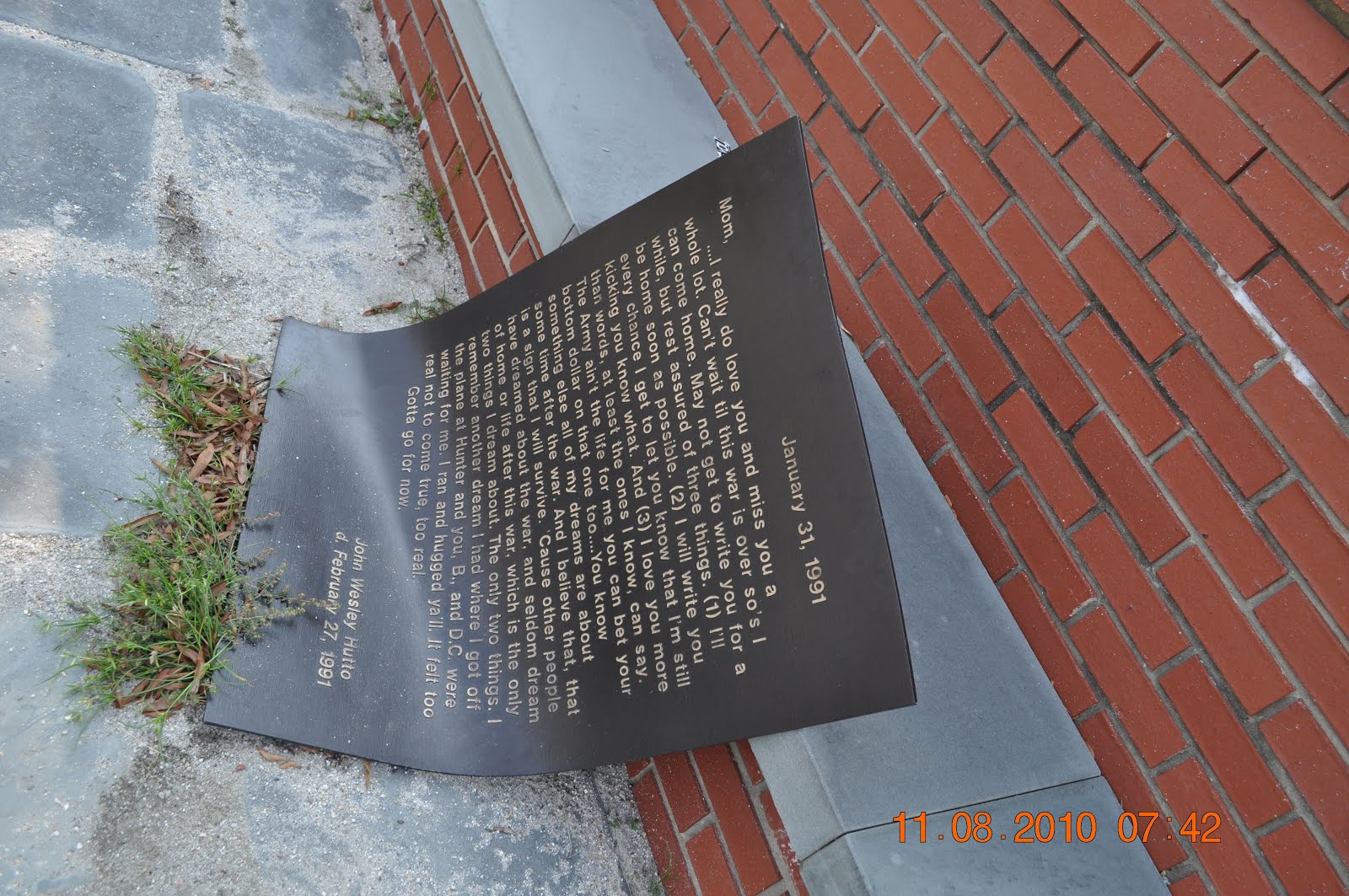

KIA Gulf War. On February 27, 1991, John Wesley Hutto died during Operation Desert Storm in Iraq at the age of 19. He was a n Private First Class for the United States Army. John was born on August 03, 1971, and was from Andalusia, Alabama.
January 31, 1991
Mom,
....I really do love you and miss you a 
whole lot. Can't wait till this war is over so I
can come home. May not get to write you for a
while, but rest assured of three things. (1)I'll 
be home as soon as possible. (2) I will write you
every chance I get to let you know that I'm still
kicking you know what. and (3) I love you more
than words, at least the ones I know, can say.
The Army ain't the life for me, you can bet your
bottom dollar on that one too...You know
something else, all of my dreams are about
some time after the war. And I believe that that
is a sign that I will survive. 'Cause other people
have dreamed about the war and seldom dream
of home or life after this war, which are the only
two things I dream about. The only two things I 
remember were another dream I had where I got off
the plane at Hunter, and you, B., and D. C. were
real, not to come true, too real.
Gotta go for now.
John Wesley Hutto 

2016 July 9, Saturday, Taking pictures around the Shoals Area

Today, I went to Chick-fil-A for a bagel with egg, cheese, and chicken. I also ordered 3 chicken Minnie with a large tea. I ate the three chicken Minnie without the bread. 

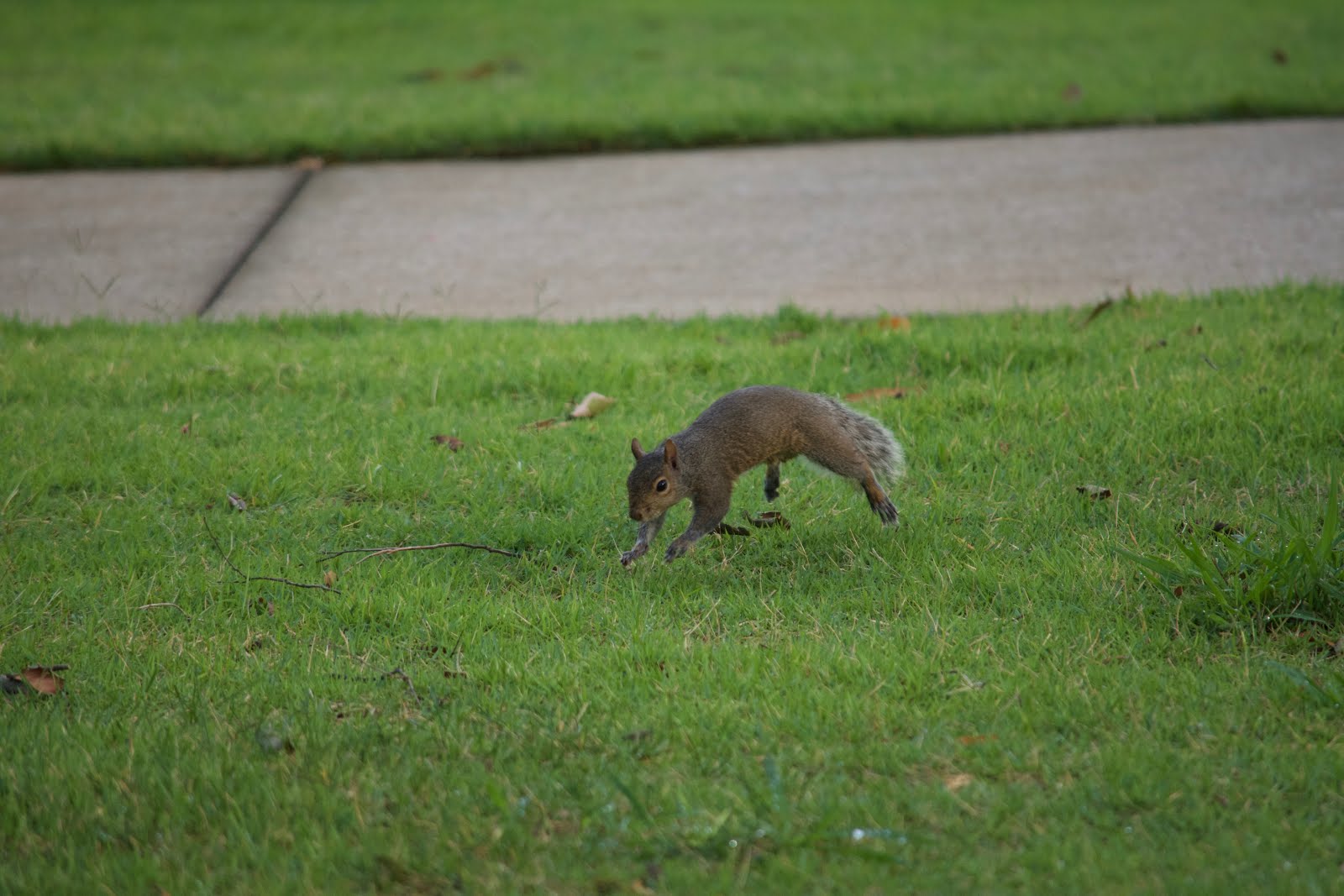
Then I rode to UNA to see the lions but they were not out I could hear them roaring. I did see several squirrels scurrying around the campus. They were looking for food and playing. Crape Myrtles were in full bloom. It was reasonably quiet, except for an occasional roar of the lions and the pitter-patter of squirrels, as I walked through the campus taking pictures.

squirrels scurrying around the campus

squirrels scurrying around the campus
Top of the fountain 
Crape Myrtles
I  rode to the W.C. Handy Home and Museum to take a few pictures outside. Outside the tin, men were playing their musical instruments, and the museum door was patiently waiting to be unlocked at 10 A.M.
Tin men playing music
WC Handy Museum Opens at 10 A.M.
I next rode to McFarland, where I discovered a Gaggle of Geese gathered on the sandy beach, and I saw two men sitting quietly in their boat, fishing. I could hear in the distance the construction on the O'Neal bridge, and I watched a couple of geese come in for a landing on the Tennessee River

Two Men Fishing

A gaggle of geese is enjoying the sandy beach of McFarland 
I  stopped at Kangaroo in Sheffield to fill up with gas. 
Then onto the railroad bridge, where I took pictures as I walked to the end and back. 
My next stop was Rock Pile Park, where I saw another Gaggle of Geese, a lot more geese than at McFarland Park. They began waddling towards me, so I went back to the van for the bread left over from my chicken Minnie.

A gaggle of geese at the Rock Pile 
I waited until I was almost at the river before I gave the gaggle of geese the bread.
I then rode down to the Children's Playground area at the Rock Pile. There was a family of three there at the park, and the little girl was having fun playing. She came up to me, said hi, and told me when I left. 


The playground area at the Rock Pile 
The playground area at the Rock Pile & the little girl who was having fun 
I stopped at the Visitors Overlook at TVA Dam, where I could see the TVA Wilson Dam, the Tennessee River, the Marriott hotel, and the tower.
Tennessee River, Wilson Dam, Tower, and Marriott view from Visitors' Overlook 
I rode across the Wilson Dam Bridge to River Heritage Park, where I took a few pictures of the Crape Myrtles in full bloom. 
Crape Myrtles.
Crape Myrtles.
Crape Myrtles.
My last stop was Aldies to buy a few groceries. They had eggs for $.49 a dozen, so I bought four dozen. I came home, unloaded the groceries, and took a nap.

Wednesday, June 29, 2016

🚗 2016 June 28, Tuesday, Day Trip to Scottsboro, Stevenson, Menton, Fort Payne , Section, Alabama

Today we took hwy 72 east through Scottsboro, stopping at Taco Bell for lunch, which was not a good idea. Made both of us have stomach problems later that day. I ordered the Nachos Supreme and Tea. Hubby ordered the $5 meal deal.
We rode on to Stevenson, Alabama, to see the Stevenson Train Depot and Hotel, but the museum was closed.

Stevenson Depot and Hotel 
Reverse:
After the war, the depot and hotel continued as the center of life in Stevenson. Trains stopped here at mealtimes, and passengers ate in the hotel dining rooms. Other passengers spent the night here; the hotel is so close to the tracks that it was said the trains "opened the hotel windows and pulled the covers off the beds." Generations recalled the final passenger
Departures and arrivals here are often sad and poignant, especially during wartime.
A group of citizens saved the depot from destruction during the Bicentennial in 1976 when the last railroad office closed. The depot was renovated for use as a community museum, which opened in June 1982. 
Listed on the National Register of Historic Places 5/13/1974
Stevenson Depot and Hotel 
A one-story depot building was constructed here in 1853 when the railroad was first laid through Stevenson. That building burned after the Civil War and was replaced by the present brick depot and hotel in 1872.
During the Civil War, Stevenson was a hub of activity. Union and Confederate troops skirmished here, and the town changed hands more than once, though Stevenson mostly lay under Union control. Troops occupied the city, and a large refugee camp sprang up between the depot and Ft Harker, a quarter-mile east.
Tens of thousands of soldiers, horses, wagons, prisoners of war, refugees, wounded men, and others passed through Stevenson during the late summer and fall of 1863, before, during, and after the Battles of Chattanooga and Chickamauga. Harper's Weekly, an influential newspaper of the time, noting the juncture of East-West and North-South rail lines here, called Stevenson "One of the seven most important cities in the South."
Stevenson Train Depot 
The sign outside said 'open Monday-Friday, 8–3:30 P.M.,' but it was closed.
Stevenson Depot Museum Hours: Mon-Fri, 8:00 A.M.–3:30 P.M.
I took a few pictures, and we stopped at the Co-op next to the depot for some more seeds and supplies to deter the groundhogs and rabbits.
Co-Op
We rode through Stevenson Park, where we saw an old cabin, a steam engine, birding trails, a ballpark, and a mural about the Tornado of April 27, 2011, that hit the surrounding areas.
100-year-old Cabin 
Steam engine
We took hwy 117 to Desoto Park, stopping in Menton. We stopped at
Desota Falls, where we walked down the steps that led to the large boulder near the falls, but we were very disappointed because the falls were almost dried up. Water was falling, but not in significant quantities. The damned area was full of people swimming, and two men were trying to push a log over the dam.
Several people came to see the falls, and a few walked further down the walkway, but we stopped at the top.
Desota Falls
Swimming at Desota Falls
We rode to Fort Payne, stopping at Mayfield Ice Creamery for one scoop of Rocky Road and one of Cherry Vanilla, which we shared. 
Mayfield Ice Creamery 
We saw the Junkasorus along the way, then rode through Fort Payne without stopping. 
Junkasorus
We took Hwy 35 back to Scottsboro, stopping at a park overlooking the Tennessee River, which was a beautiful sight. The park was next to several large homes.
Train Depot in Fort Payne 
Weathington Park is dedicated to the perpetual Public use of the citizens of the Town of Section by Scott & Patty Weathington and gratefully received on behalf of its citizens by Bob Matthews, Mayor of 2012
Weathington Park overlook 
We crossed the bridge at Section, where we could see the Bellefonte Plant.
From Scottsboro, we traveled to Kroger's in Huntsville to fill up with gas. They usually have the best mid-grade gas prices.

We stopped at Cracker Barrel in Athens for dinner.
My husband ordered a bowl of soup and a hamburger, but he was unable to finish either. I ordered a child's vegetable plate of pinto beans, turnip greens, chow chow, and cornbread. I ate the crust off of one of the cornbreads, finished the beans, and left about half the greens.
Hamburger
Pinto Beans, Turnip Greens
We were home by 7 P.M.
My stomach hurt all night, but I'm not sure if it was the Nachos Supreme, the beans, or both.

2016 June 19, Sunday, Singing River Statue of Muscle Shoals 🎶🎶🎶🎶

Legend of the Singing River
The Yuchi and other early inhabitants living along the banks of the mighty Tennessee River held the legend of a Spirit Woman who lived in the river. She protected and sang to them. When the river was angry, she sang loudly. When the river was peaceful, she sang softly and sweetly, sometimes humming a comforting lullaby. Some say that all they heard was the high waters' mighty rush and roar over the mussel shoals, or at other times, the calm, low waters babbling through the river rocks. Others say she is real and can still be seen in the early morning mist, hovering over the waters, just as she did those many years ago. In her honor, they called it the Singing River, and in her honor, we named these sculptures the Singing River Sculptures.
Singing River Statue of Muscle Shoals
Singing River Statue of Muscle Shoals 
The World-Changing Muscle Shoals Music
From the 20th century to the present, artists, musicians, songwriters, and music-industry professionals from the Muscle Shoals area have helped shape the world's expansive music heritage. Few musical styles were untouched by Muscle Shoals, and local contributions have been made across all areas of the music industry, including production, recording engineering, songwriting, music publishing, and various positions within the music business.

Many of the world's most outstanding performers began their ascent to stardom in Muscle Shoals, and artists such as Percy Sled, Aretha Franklin, the Staple Singers, and Bob Seger, along with many others, quickly created a legacy that earned the area the title, "Hit Recording Capitol of the World."

The area grew as a music center by drawing together people of all races and religions. In the 1960s, despite segregation enforced outside the studios, great soul classics were being created within them, with each musician contributing their innate musical talent. The collaborations created some of the most widely loved music of the 20th century, including Steal Away, Mustang Sally, Tell Mama, Patches, Respect Yourself, and many others.

The warning issued in Arthur Alexander's "You Better Move On" caught the attention of the Rolling Stones. The Beatles heard Alexander's song, "Anna," and each band acknowledged their respect for Alexander and his writing by recording their own versions of his songs on their first albums.

The songwriting tradition continues as one of the strongest facets of Muscle Shoals music, with area songwriters penning songs such as I Loved Her First, I Swear, 

The heart and soul of Muscle Shoals' music have always been the players and singers. Four members of the Muscle Shoals Rhythm Section were immortalized in the Lynyrd Skynyrd song, Sweet Home Alabama. The lyric, "Muscle Shoals has got the Swampers, and they've been known to pick a song or two," honors Jimmy Johnson, Barry Beckett, David Hood, and Roger Hawkins, studio musicians who produced and played on hundreds of hits recorded at area studios from the late 1960s until the mid-1980s.

Muscle Shoals and Its Contribution to This Golden Era
Muscle Shoals bestowed much more than its name on the world-famous "Muscle Shoals sound."

The city served as the birthplace for early breakthroughs in the local music industry and later provided a home base for some of the area's top studios. The first commercial recording to emerge from Muscle Shoals — the Bobby Denton single, A Fallen Star — was produced by James Joiner in the Second Street studios of WLAY Radio in 1957. Four years later, in an old candy-and-tobacco warehouse on Wilson Dam Road, aspiring producer Rick Hall joined forces with bellhop-turned-singer Arthur Alexander to cut Muscle Shoals' first national hit, the Southern Soul anthem, You Better Move On. In the wake of that success, Hall built FAME Recording Studios on Avalon Avenue in 1962. Artists ranging from Aretha Franklin, Wilson Pickett, and Etta James to Duane Allman, the Osmonds, and Bobby Gentry later recorded there. From 1970 to 1985, Muscle Shoals became known as "The Hit Recording Capital of the World" as FAME and Al Cartee's Music Mill, Steve Moore's East Avalon, and Terry Woodford and Clayton Ivey's Wishbone Studios generated hits by Clarence Carter, Hank Williams Jr., the group Hot, George Jones, the Forester Sisters, Mac McAnally, Shenandoah, and many others. In 2011, Hall received the American Music Lifetime Achievement Award, and in 2014, he was honored with the Grammy Trustees Award for his significant contributions to the recording industry.

The City of Muscle Shoals, Alabama
David Bradford, Mayor
Audwin Pierre McGee, Sculptor
Historical commentary by Terry Pace, Dick Cooper, David Anderson, and Bill Matthews.
Rick Hall and Duane Allman
FAME Studio at 601 E. Avalon Avenue (Photo furnished by FAME)
James Joiner and Bobby Denton at WLAY Radio 
Muscle Shoals City sign proclaiming it the Hit Recording Capital of the World (Photo furnished by FAME)
Wishbone Studios (Photo furnished by Terry Woodford)
East Avalon Studios (Photo furnished by Dick Cooper)
FAME Studio at the old Candy and Tobacco Warehouse (Photo furnished by FAME)


Footprints in the Sand and other Poems by famous authors

  One night, a man had a dream. He dreamed he was walking along the beach with the Lord. Across the sky, scenes from his life flashed. For...