A day trip to Corinth, MS.
Our first stop was 1551 Horton Street at the Corinth National Cemetery, which was established in 1866 as a central burial site for approximately 2,300 Union casualties of the Battle of Corinth.
Many of the tombstones are unknown (represented by a number). Soldiers represented by 273 different regiments from 15 states. The cemetery is well kept with rows and rows of white tombstones. We saw "An Act" as a marker for establishing and protecting National Cemeteries.
We also saw a marker addressed by President Lincoln at the dedication of "the Gettysburg National Cemetery" on November 19, 1863.
There were several large trees throughout the cemetery.
 |
A marker with a poem
The muffled drum's sad roll has beat
The soldier's last tattoo.
No more on life's parade shall meet
That brave and fallen few.
On Fame's eternal camping-ground
Their silent tents are spread,
And Glory guards, with solemn round,
The bivouac of the dead.
|
 |
| Corinth National Cemetery |
 |
| A National Cemetery System |
An estimated 700,000 Union and Confederate soldiers died in the Civil War between April 1861 and April 1865. As the death toll rose, the U. S. government struggled with the urgent but unplanned need to bury fallen Union troops. This propelled the creation of a national cemetery system.
On September 11, 1861, the War Department directed commanding officers to keep "accurate and permanent records of deceased soldiers." It also required the U. S. Army Quartermaster General, the office responsible for administering to the needs of troops in life and in death, to mark each grave with a headboard. A few months later, the department mandated the interment of the dead in graves marked with numbered headboards, recorded in a register.
Soldier's graves near General Hospital, City Point, Va., c1863. Library of Congress
Creating National Cemeteries
The authority to create military burial grounds was granted by the Omnibus Act of July 17, 1862.
It directed the president to purchase land to be used as "a national cemetery for the soldiers who shall die in the service of the country."
Fourteen national cemeteries were established by 1862.
When hostilities ended, a grim task began. In October 1865, Quartermaster General Montgomery C. Meigs directed officers to survey lands in the Civil War theater to find Union dead and plan to reinter them in new national cemeteries. Cemetery sites were chosen where troops were concentrated: camps, hospitals, battlefields, and railroad hubs. By 1872, 74 national cemeteries and several soldiers' lots contained 305,492 remains, about 45 percent of which were unknown.
Knoxville was established after the city's siege and the Battle of Fort Sanders in 1863. Cemetery plan,1892, National Archives and Records Administration.
Lodge at City Point, Va., pre-1928. The first floor contained a cemetery office, living room, and kitchen for the superintendent's family; three bedrooms were upstairs.
Most cemeteries were less than 10 acres in size, and layouts varied. In the Act to Establish and Protect National Cemeteries on February 22, 1867, Congress funded new permanent walls or fences, grave markers, and lodges for cemetery superintendents.
At first, only soldiers and sailors who died during the Civil War were buried in national cemeteries. In 1873, eligibility was expanded to all honorably discharged Union veterans, and Congress appropriated $ 1 million to mark the graves. Upright marble headstones
honor individuals whose names were unknown; 6-inch-square blocks mark unknowns.
By 1873, military post cemeteries on the Western frontier had joined the national cemetery system. The National Cemeteries Act of 1873 transferred 82 Army cemeteries, including 12 of the original 14, to the National Cemetery Administration.
Reflection and Memorialization
The country reflected upon the Civil War's human toll-
2 percent of the U. S. population died. Memorials honoring war service were built in national cemeteries. Most were donated by regimental units, state governments, and veterans' organizations such as the Grand Army of the Republic.
Decoration Day, later known as Memorial Day, was a popular patriotic springtime event that began in 1868. Visitors placed flowers on graves and monuments and gathered around rostrums to hear speeches. Construction of Civil War monuments peaked in the 1890s. By 1920, as the number of aging veterans dwindled, more than 120 monuments had been erected in the national cemeteries.
National cemetery monuments left to right: Massachusetts Monument, Winchester, Va., 1907; Maryland Sons Monument, Loudon Park, Baltimore, Md., 1885; Women's Relief Corps/Grand Army of the Republic Monument to the Unknown Dead, Crown Hill, Indianapolis, Ind., 1889.
 |
| Benjamin Franklin Liddon Home |
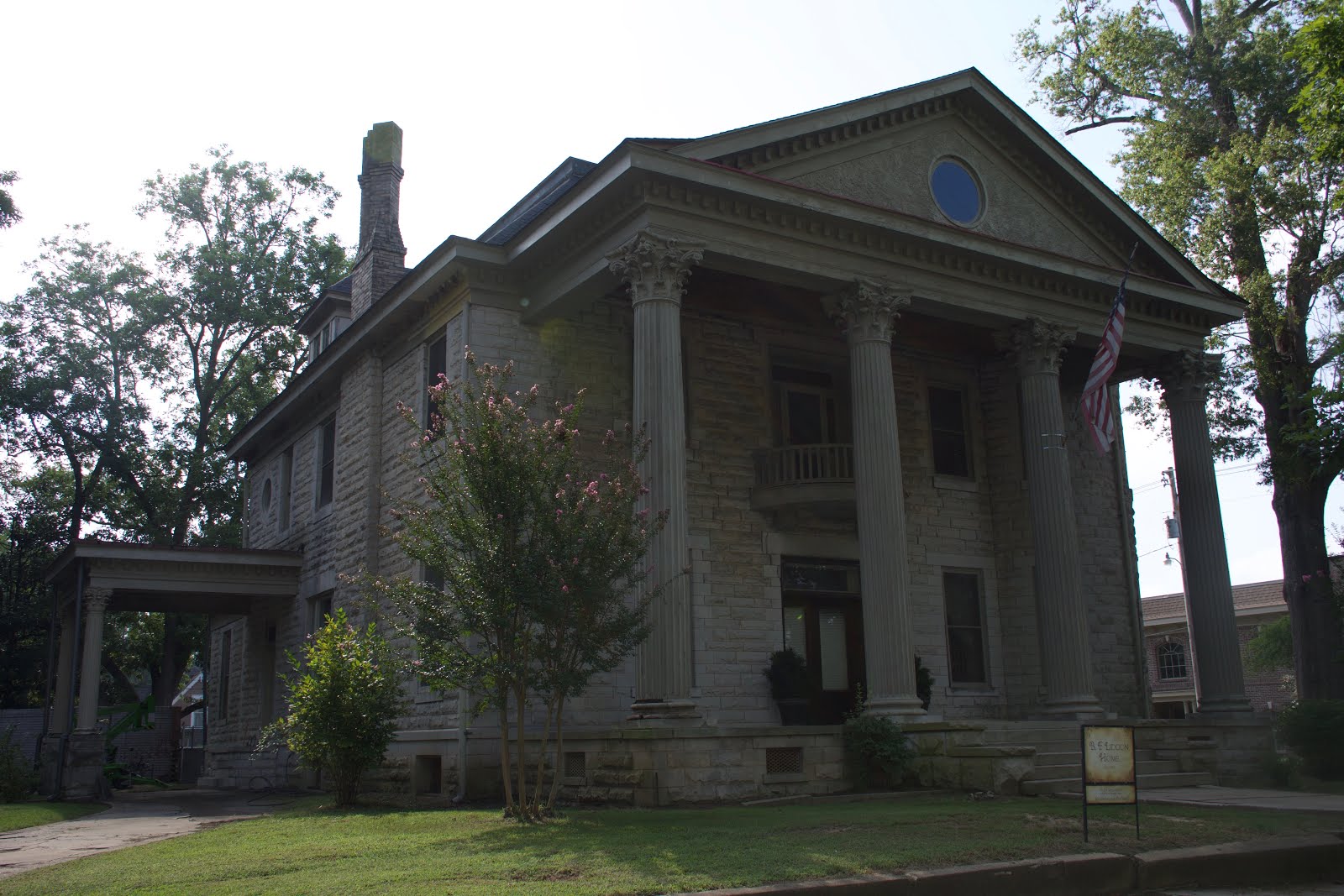 |
| Benjamin Franklin Liddon Home |
We rode past the Benjamin Franklin Liddon Home (called the Cat House) build circa 1907, which was under renovation by Richie and Margret Mathis.
This castle home is located at the corner of Webster and Bunch streets.
Mr. Liddon was an eccentric businessman and an architect who loved motion pictures and wanted to bring entertainment to the area.
The castle-like home has Corinthian columns, imported from New York, intricate stonework, and turrets (an eye-catcher).
 |
| Fillmore Church, Corinth's oldest church |
We stopped at the Fillmore Church, Corinth's oldest church. It was erected in 1871 by the Cumberland Presbyterian Church. The building was constructed of load-bearing red brick walls (faded over time) and windows with lancet arches. The central steeple is attached to the front facade of the building, with a red-slate triangular roof.
 |
| Site of Rose Cottage |
The site of Rose Cottage faced the Fillmore Church.
The Rose Cottage was the headquarters for Confederate General Albert Sidney Johnston, who had received a fatal wound at the Battle of Shiloh.
I walked up the street to the Oak Home, where I took several pictures.
Judge W. H. Kilpatrick of Corinth had Oak Home built in 1857 by Tom Chesney, a local house designer and builder. Mr. M. S. Miller, a civil engineer working in Corinth shortly before the war, made this sketch in 1860, the only known Civil War vintage picture of Oak Home. Miller notes that a wood fence surrounded the whole block and that the ""ine house" was straw-colored with a yellow door bordered by sidelights.
Also, a green magnolia plaque marker was found in front of the Oak Home at 808 N Fillmore Street.
The house had a black shingle-hipped roof, with two chimneys, a triangle-covered porch, an entrance with white siding, and was surrounded by a white picket fence.
 |
| OAK HOME |
Built in 1858 for Judge W. H. Kilpatrick. Used in the Civil War as the headquarters of General Leonidas Polk. Bought in 1866 by Mrs. Thomas Quincy Martin and occupied continuously by her descendants.
 |
| Curlee House, built in 1857 |
Our next stop was the corner of Jackson and Childs Streets to tour the Curlee House, built in 1857 and an example of Greek Revival architecture. The restored home contains eighteenth and nineteenth-century paintings, antiques, and Civil War memorabilia.
The house was a one-story mansion with high ceilings and mural walls in the hallway. It had a kitchen, dining room, and two bedrooms. Both front rooms had floor-to-ceiling mirrors, fireplaces with huge wooden mirrors above, and crystal chandeliers hanging from the ceiling.
 |
| Mathushek Piano |
There was a Mathushek Piano manufactured in New Haven, CT, patented June 24, 1894, sitting in the hallway.
Mathushek was one of the greatest innovators in piano design. He established his firm in 1863, and he built his pianos in partnership with Driggs. He moved his firm to New Haven, CT, in 1866. He built a line of square grand that was very different from their contemporary competitors. These square pianos were known as the Colibri and the Orchestral models. The piano in the hallway was an Orchestral model. Above the keys, opened and displayed, was the song "Beautiful Star of Heaven".
Curlee House Marker
One of Corinth's founders, surveyor Hamilton Mask, built this Greek Revival home in 1857, as shown above in an 1862 photograph. It became known as the "Verandah House" because of its porches and served as headquarters for both Union and Confederate officers. William P. Curlee, whose name it now bears, bought the property in 1875. Except for minor changes, it appears much as it did in 1862 today. You are invited to tour the house during its open hours.
During the war, high-ranking officers customarily occupied private homes for use as dwellings and headquarters. The generals pictured above occupied the Curlee House at different times in 1862.
Gen. Braxton Bragg, CSA, Gen. John B. Hood, CSA, Gen. Henry W. Halleck, USA
We walked outside, where we saw a small vegetable garden, flower gardens, a sitting area, restrooms, and the Verandah House 1857.
The building to the left in the photograph is believed to have been the kitchen for the Verandah House, 1857. Kitchens in the 19th century were often located outside structures to reduce the risk of fire, as cooking was done in an open fireplace. Homes in this period, of necessity, were largely self-sufficient. Outside utility buildings, including kitchens, stables, carriage houses, smokehouses, spring houses, and privies, were needed to house these various activities. Many of the outbuildings were conveniently located in close conjunction with the main house and, as a result, became essential elements in the design of the grounds and gardens.
Fresh vegetables, herbs, fruit trees, and flowers were often grown near the kitchen. Summers are spent canning and picking many of the fruits and vegetables harvested. Herbs were used as flavorings and for various medicinal purposes. Some of the plants and flowers grown in the Verandah House kitchen garden were favorites of Stephanie Sandy, and most were favorites during the 19th century, too.
Three sides of the house had exterior entrances, and there was a basement on the back side.
On the side of the house without an outside entrance, facing a white siding house that reminded me of the Amityville Horror House.
Would not want to have them as neighbors.
 |
| Amityville Horror House in Corinth |
 |
| Amityville Horror House |
 |
| Abe Reubel House |
Our next stop was outside the Abe Reubel House, 1109 Jackson Street, built in 1904 in the Neoclassical style, with Georgian Revival influences. It had three bailed dormers on the roof, each with cornice returns.
The central dormer had a Palladian window.
 |
| B&B Generals Quarters Inn, 924 North Fillmore Street. |
We saw the finely restored 1872 grand Victorian home in historic Corinth, called the B&B Generals' Quarters Inn, 924 North Fillmore Street.
 |
| Waldron Street Christian Church |
We stopped to take a picture of the Waldron Street Christian Church, built to complement the style of the original church built in the 1900s.
We rode downtown, stopping for lunch at Borroum's Drug Store and Soda Fountain.
Hubby ordered a cheeseburger with onion rings. I wanted to try the Slug burger, served with onions, lettuce, tomatoes, mustard, and a bag of baked chips.
The Slug Burger is a patty made from a mixture of beef or pork and an inexpensive extender such as soybeans. It is deep-fried in oil.
According to town legend, the term "slug burger" comes from the slang term for a nickel.
 |
| Slug Burger |
 |
| Reading the history of the Slug Burger |
 |
| Ordering the Slug Burger |
 |
| Camille Barroom Mitchell, the pharmacist |
 |
| The Soda and Ice Cream Counter |
 |
| Paying the tab and purchasing a cookie |
'https://video.search.yahoo.com/search/video;_ylt=AwrBT7o9KcxXcB8AeBZXNyoA;_ylu=X3oDMTEyaDkyMWp1BGNvbG8DYmYxBHBvcwMxBHZ0aWQDQjE3OTNfMQRzZWMDc2M-?p=Borroum%27s+Drug+Store+Utube&fr=aaplw#id=3&vid=aeda1d252f5847afb74b9072b2f442aa&action=views
Borroum Drug Store is Mississippi's oldest drug store, established in 1865 and still in the family. Camille Barroom Mitchell, the pharmacist, is the great-granddaughter of Doctor A. J. Barroom, who started the store after the Civil War in 1865.
Borroum Drug Store is Mississippi's oldest drug store, established in 1865 and still in the family. Camille Barroom Mitchell, the pharmacist, is the great-granddaughter of Doctor A. J. Barroom, who started the store after the Civil War in 1865.
Met this sweet lady, she was reading the new paper, and looking at the ads. She was talking about the price of something, which is $12.99, and though the price might go down, it went up instead.
Camilla was sitting at a table across from us, she talked to us, while I ate my slug burger.
Everyone we met at the Drug Store was friendly, and the food was good. The next time we are in Corinth, we will be going back for a visit.
I want to try their cornbread salad. I watched as one of the waitresses made the cornbread salad for a couple sitting behind us.
First, she crumbled up a handful of cornbread, then poured a large dipper full of hot chili, next to a couple of handfuls of lettuce, tomatoes, and shredded cheese, and topped with Jalapeño peppers.
We walked up front to pay, cash only! On the counter was a cake plate full of cookies.
There was oatmeal, chocolate chip, Macadamia, oatmeal-raisin, and chocolate with coconut cookies.
There was oatmeal, chocolate chip, Macadamia, oatmeal-raisin, and chocolate with coconut cookies.
We bought one of the oatmeal raisin cookies with coconut and chocolate.
We rode to the Corinth Civil War Interpretive Center. We saw many items found during the Civil War that had been placed on the concrete sidewalk. We saw canteens, belt buckles, shells, bullets, hats, food pails, shovels, a gun, rifles, and other items.
At the entrance to the wall was a bronze plaque of six Confederate Soldiers carrying rifles.
Inside, we were greeted by a National Park Ranger. He said we could watch a film in about 20 minutes and, in the meantime, tour the museum. FREE!!
We walked outside to see a couple of cannons and a flowing fountain, with markers for different battle sites during the Civil War.
 |
| Bronze plaque of six Confederate Soldiers |
 |
| Corinth was the beginning of freedom. |
Last, we watched a ten-minute film about the Civil War.
We bought hamburger meat and shrimp at Foodland for supper.
We had a great day, saw many sites, and learned some history about Corinth during and after the Civil War.
 |
| Traveling Home |