 |
|
Famous inventor and businessman Thomas Edison visited Forty Myers in early 1885. He planned to find a warm retreat to escape the cold winters of his home base in West Orange, New Jersey. Along with friends, he made his way to Fort Myers from the cooler climate of Jacksonville.
Real estate agency Hueisenkamp & Cranford helped Edison find a 14-acre property along the Caloosahatchee River in the countryside, one mile south of Fort Myers. The grounds were scrub primarily and wild vegetation, and the plants included Giant Green Bamboo, a natural fiber Edison was experimenting with as a filament for the incandescent light bulb.
After buying the property from cattleman Samuel Summerlin for $2,750, Edison made plans by creating a notebook that included a sketch illustrating his ideal winter retreat. His sketch included homes, a laboratory, a maintenance shop, and gardens for exotic and edible plants.
|
 |
|
In 1909, a major project was undertaken to install a fire control system at the Edison estate. Water for the system was supplied from a well on the east side of the property (across McGregor Boulevard) and directed to three large tanks on the west side. From there, it was piped to five locations via a 5-inch underground water main with 3-inch branch pipes.
At each location, a standpipe had a hose rack and a reel with 100 feet of 2-inch hose. The sandpipes were located at:
. The Main House
. The Guest House
. The Caretaker's Cottage
. The Original 1886 laboratory
. A location on the east side of McGregor Boulevard
Several standpipes, including those at the Main House and Guest House, can still be seen today.
Fire control was enhanced in 1919 when five portable Pyrene fire extinguishers were installed inside the following areas, and chemical extinguishers hung outside:
. Thomas and Mina Edison's bedroom
. Sitting Room
. Dining room
. Kitchen
. Caretaker's Cottage garage bay
Today, historic structures at the Edison and Ford Winter Estates are outfitted with a state-of-the-art VESDA (Very Early Smoke Detection Apparatus) system and a Borrell Mist system.
When fire or smoke is detected,
tiny water droplets and pressurized gas are delivered. As droplets come into contact with the fire, they convert to steam, absorbing energy from the burning surface. As the steam expands, it lowers the firing temperature and prevents oxygen from reaching the fire, which smothers it.
Also, the porches of the Edison houses feature a water sprinkler system to extinguish any fire outside, along with portable fire extinguishers.
|
 |
|
— February 11, 1847 – October 18, 1931
Named the 20th century's "Man of the Millennium" by LIFE Magazine, Thomas Alva Edison is best known for inventing the commercially viable incandescent light bulb. However, Edison was also a newspaper printer, telegrapher, and inventor who "transformed middle-class life." He discovered many commercial applications for ordinary materials and agricultural products. Although his favorite invention was the phonograph, his work spanned improvements to the telegraph, the light bulb, generators and motors, movie-making, batteries, cement, and a domestic source of rubber, one of his primary research focuses in southwest Florida.
From his first visit in 1885 to his last stay in Fort Myers in 1931, Edison created a remarkable estate that included areas for his research, family, and social activities. His love of Florida included pastimes such as fishing, boating, reading, trips to town, and exploring the tropical paradise he affectionately called his "Eden."
Edison's famous quote, "There is only one Fort Myers, and soon 90 million Americans will discover it", has proven true. Thousands of national, international, and Florida residents visit the Edison & Ford Winter Estates annually.
This Statue of Thomas Edison was donated by the Estate's Alderman and created by sculptor D. J. Wilkins in 2004.
|
 |
Edison Guest House's in Seminole Lodge Guest Book —Harrie Monkhouse Guest March 21-April 3, 1916 Have you ever dreamed a dream of Heaven? Where the Garden of Eden Grows? Come down with me to the Florida Coast, where the Caloosahatchee flows.
Come down with me to Seminole Lodge
Where grapefruit & orange bloom,
Where bananas & palm trees skirt the shore
Of the pool you swim in at noon
Come down with me & meet our dear Hosts,
In this Heaven of sunshine & haze,
And then you'll know why on the Florida coast-
The birds brush their throats in mere praise-
The home was initially built for Edison's good friends Ezra and Lillian Gilliland as their winter retreat. The Gillilands lived in Fort Myers for only three years and sold the home to Ambrose McGregor in 1891. The McGregor family lived year-round in the house until 1902. The road along this home was named McGregor Boulevard in honor of Mr. McGregor in 1914.
Edison purchased the home in 1906 and created a guest house for family and friends. This building houses the dining room, kitchen/pantry area, and servants' quarters for the s.
Visitors like Henry Ford and Harvey Firestone stayed for days, while Charles Lindbergh came for dinner. Many received
reminders of Florida visits when mangoes, grapefruit, guava, and orange marmalade would arrive at their northern homes
|
 |
|
— Planted as a sapling circa 1927 —
Native to South Asia
Edison, Ford, and Firestone formed the Edison Botanic Research Corporation in 1927 to find a fast-growing, natural rubber source that could be grown in the United States. The banyan tree was one of more than 17,000 plant specimens tested during this project.
Ficus trees, such as the banyan, produce a fair amount of latex. However, labor costs and the tree's slow growth made this option impractical for Edison, who sought a plant that could be harvested several times a year.
The Banyan tree (also known as the walking tree) is native to the heart of the rubber-producing region of southern Asia, which dominated the rubber market during the 1920s and 30s.
Banyans are among the more than 800 species in the genus Ficus. Their long branches support themselves by producing aerial roots that grow downward into the ground, forming pillar-like trunks. There are over 13 types of Ficus throughout Edison Ford's gardens.
Historical documents reveal that he banyan was planted as a sapling on the Edison property around 1927. It is the most enormous banyan in the continental United States, with a canopy that covers almost one acre.
|
 |
|
The pier was initially called "the wharf." Beginning in November 1885, it was used as a working area to offload boats carrying materials and contents for the homes and laboratory. After the Estate buildings were completed, the pier's initial function changed.
Mina's correspondence to the family in 1909 states, "Thomas caught a trout, snapper, and I think a small tarpon, which he did land, right off the pier… We may supper there this evening, I am not sure."
By this time, Edison had improved the pier by lengthening it into the Caloosahatchee River by about 1,500 feet and adding small docks, boathouses, and a summer house. The area was routinely used as a leisure and recreational gathering place.
The many beautification improvements to the grounds in the 1920s included the addition of a feature at the pier entrance. It comprised a rustic bridge, benches, and a trellis wrapped with a colorful bougainvillea vine. Besides creating a new spot to sit along the riverbank, the feature enhanced the impressive view across the river lawn as guests entered the Estate via the Estateite.
|
 |
|
"Madeleine, Marie, Theodore, and the two maids gone bathing in the hotel pool—so everybody is happy, wrote Mina to family on April 7, 1909. By the 1911 winter season, the family and staff no longer had to travel downtown to the Royal Palm Hotel pool. Edison had a bathing pool built right on his own Estate. Estate Estates were constructed by W.R. Wallace and the Company of Fort Myers. The work includes an entire floor and walls made of concrete reinforced with woven wire or expanded metal, corners for 10 feet reinforced with ½-inch twisted iron bars, and the sides and bottom made continuous by the interweaving of the metal. Initially, it included stone steps leading to the pool, a plank walk around the exterior, a board fence, and dressing rooms on the southeast corner. The final cost of the project was about $1,000.
The swimming pool underwent significant changes in 1928 to meet more modern needs. The remodeling plan was designed by the local architect, Nat Gaillard Walker. Concrete walks around the pool, pipe framing for the railing fence and pavilion, a tea house, a fountain, and a bathhouse with showers were added. All features were attached to create a single combined entertainment area.
The pool complex remained a favorite spot for the Edison family, as Madeleine relates in a letter to her mother on March 10, 1947:
"We did enjoy the lazy days at Fort Myers—I couldn't have borne it not to see the place again, it always was—and I'm glad it was warm enough for a farewell swim in the pool!"
|
 |
|
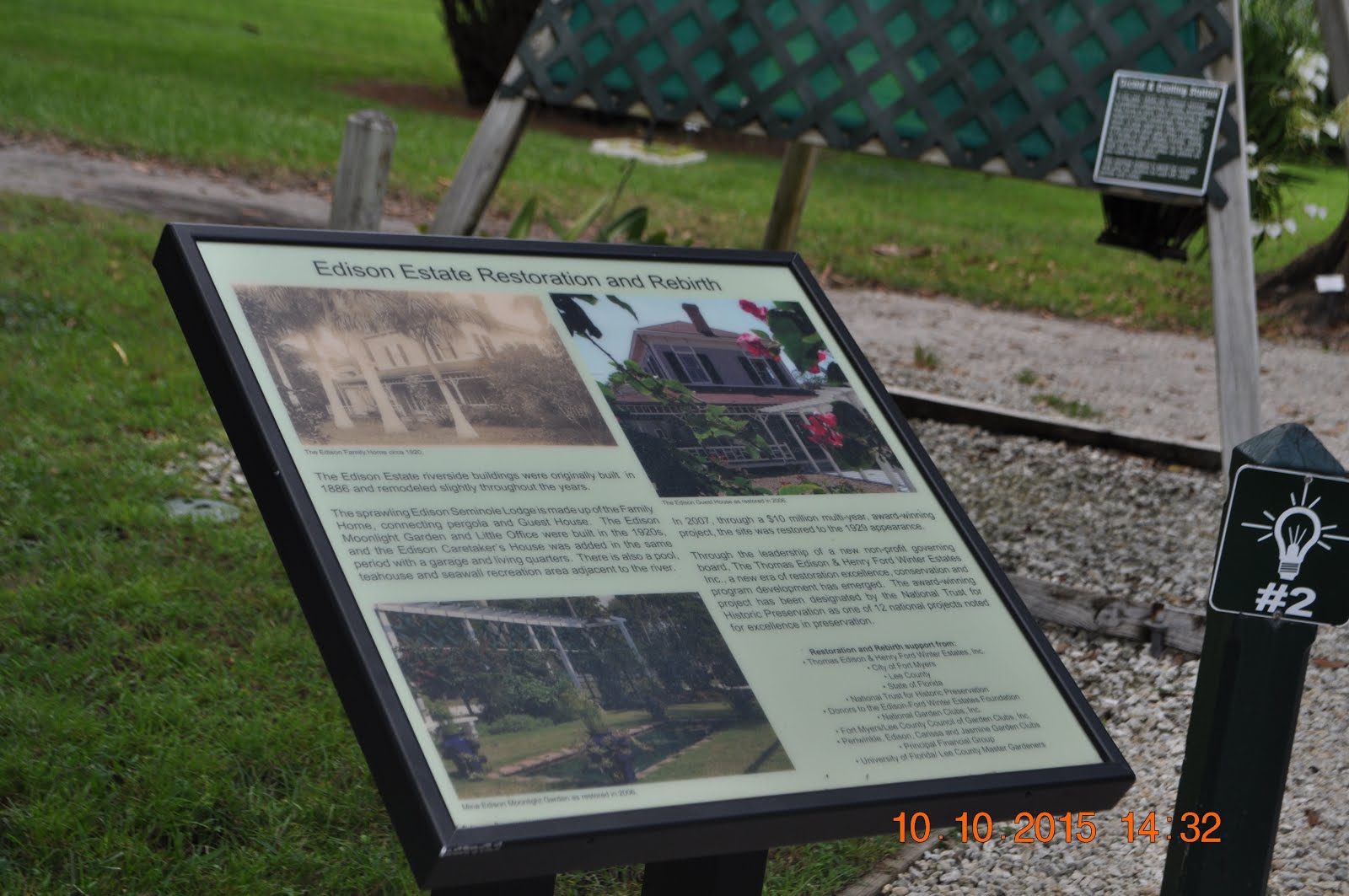
The Edison Estate's riverside buildings were built in 1886 and have been slightly remodeled over the years. The sprawling Edison Seminole Lodge comprises the Family Home, a connecting pergola, and the Guest House. The Edison Moonlight Garden and Little Office were built in the 1920s, and the Edison Caretaker's House, with a garage and living quarters, was added in the same period. A pool, teahouse, and seawall recreation area are also adjacent to the river.
In 2007, through a $10 million multi-year, award-winning project, the site was restored to its 1929 appearance.
A new era of restoration excellence, conservation, and program development has emerged through the leadership of a new non-profit governing board, The Thomas Edison & Henry Ford Winter Estates Inc. The award-winning project has been developed and emerged. The National Trust for Historic Preservation has designated it as one of 12 national projects noted for excellence in preservation.
Restoration and Rebirth support from:
. Thomas Edison & Henry Ford Winter Estates, Inc.
. City of Fort Myers
. The state of Florida
. National Trust for Historic Preservation
. Donors to the Edison-Ford Winter Estates Foundation
. National Garden Clubs, Inc.
. Fort Myers/Lee County Council of Garden Clubs, Inc.
. Periwinkle, Edison, Carissa, and Jasmine Garden Clubs
. Principal Financial Group
. The University of Florida/Lee County Master Gardeners
|
 |
|
Edison created a sizeable domestic support area for the EEstate on the estate side of McGregor Boulevard. Storage buildings, equipment, a truck garden, and an estate horse were located there. The Caretaker's House will be retained and expanded on the west side. The northern end of the leading Estate provides a space, though on a smaller scale. In the early years, a hog wire fence separated the domestic area. Wheelbarrows, wagons, ladders, rakes, and garden tools were often visible.
A warehouse was built in this section to store construction materials for the houses. It likely continued storing various estate supplies until moving to the east side in 1913. A large chicken house and run were located close to the house. The staff and the family welcomed the fresh eggs and chickens. This enormous structure was razed when the existing cistern was built in 1919. A smaller house and a run were then built.
Beehives were also located in the yard, R. W. Kellow, a secretary to Mr. Edison, describes in a 1917 report of the state, "I restated that a portion of the honey produced is consumed by the Edison family duriEstate occupancy of the estate, but that it has not been the practice to have any of the honey shipped to Orange." (West Orange, New Jersey, where the main.
Edison's home is located)
|
 |
Edison's invention and business life included extensive and successful work with integrated power systems. In 1886, Edison placed an "isolated" power system on the south end. Edison was interested in bringing electricity to the rest of Fort Myers, but several reasons prevented the project. Years later, in 1898, local resident A.A. Gardner franchised the city's first electric plant.
By 1919, the electrical lines extended beyond Edison's property. At that time, Edison disassembled the original power system components and sent them to his New Jersey laboratory. Today, they can be viewed at the Henry Ford Museum and Greenfield Village in Dearborn, Michigan.
|
 |
|
” — -Thomas Edison
"Beyond doubt, you have the finest place in the country, and if you build a seawall in a few years, this section will not be large enough to hold the tourists eager to get here every winter. Yes, sir, by all means, build -Thomas Edison, thoughts on the proposed city seawall from a local newspaper article in 1908.
Edison built the first section of the rock seawall along with his property in 1903 and extended it along with the Guest House property in 1907. The seawall was 3' tall and 2' wide and was completed for $450. The Seminole Lodge Caretaker, Ewald Stulpner, wrote to Edison that the structure "makes a great improvement to your riverfront."
The seawall protected the property and provided a small beachfront area for the Edison family and guests. The lawn along the seawall was also an essential feature of the landscape.
Seawall Restoration 2005
. Lee County Beach and Shoreline Grant
. The state of Florida, Office of Tourism, Trade, and Economic Development
. City of Fort Myers
. Florida Gulf Coast University Archeological Survey.
|
 |
|
Some of the Seminole Lodge Staff are Queenie Adams, J.F. Anderson, Mr. Bassler, Mr. & Mrs. Black, Ellen Carr, Michael & Tina Doyle, James Evans, Harvie Heitman, William Hibble, Henry Horsey, Noah Keen, George Kinze, Fred Ot, Sidney Scarth, Edgar & Mrs. Smith, Frank Stout
Ewald Stuplner B.E. & Mrs. Tinstman Eli Thompson Hans Zeeman
A section of this building was on the grounds when Edison purchased the property in 1885 from cattleman Samuel Summerlin. In developing plans for the Estates, Edison decided to keep the house and to "repair it and use it for the employees." His improvements to Seminole Lodge in 1903 included adding a room, porches, and a bathroom to the "Summerlin House." The L-Addition created an apartment for driver Sidney Scarth and their family. A two-bay car garage and tool bay were completed and in use by 1929.
Edison relied on local help and staff from his central West Orange, New Jersey home to maintain the Estates. Staff was an integral part of the property, corresponding frequently with Mr. and Mrs. Edison about activities in Fort Myers. Staff positions included general agents, caretakers, gardeners, cooks, and drivers.
|
 |
|
— In Memory of Thomas and Mina Edison
This garden area reflects Edison's original plan for the Estate landscape. It commemorates the legacies of Thomas and Mina Edison, as well as other groups and individuals who have shaped the cultural landscape of the Edison & Ford Winter Estates.
According to his original 1885 landscape sketch, Thomas Edison intended for his Estate property to include not only homes, a laboratory, and outlying buildings but also areas for growing fruits and vegetables that could be eaten, given to friends and family, or sold by the staff via "truck gardens," which literally meant selling produce out of the back of a truck.
Edison's plan listed pineapples, citrus, peanuts, and other edible plants that could be cultivated in the tropics. He frequently created raised beds and container gardens to efficiently produce and research his plants. He also employed innovative irrigation, propagation, and fertilization practices, such as using seaweed as fertilizer and rainwater for irrigation.
In keeping with the Edison tradition, the Estate uses estate-grown food, soaps, and supplementary rainwater today.
The Estate's staff volunteers in the care, propagation, and sale of an ever-changing variety of heritage plants that reflect the Edisons' lifestyle. The Estates is also an official site of the University of Florida Extension Service Master Gardener program, and volunteer service applies.
Heritage plants for sale and classes throughout the year encourage public involvement and knowledge of the Edisons' unique horticulture and gardening interests.
|
 |
|
When Edison planned his Florida retreat in 1885, water was a significant concern for supplementing the shallow well at the existing Caretaker's House. This may have been dug for the Summerlin family before Edison purchased the property. By 1887, Edison had provided water to the Caretaker's House via a windmill that pumped water from the well to a storage tank perched on a tower. At the same time, a water tank was installed in the first lab to supply water to the steam boiler powering the electricity-generating generator. It is also believed that cisterns were located in both houses.
In 1902, Edison began creating an extensive, formal water system for the property. A well was dug next to the lab to provide a more direct water supply for the steam boiler. Between 1903 and 1908, several other wells, elevated tanks, and pumping systems were placed around the caretaker's house. Two artesian wells were dug. Pipes were laid throughout the grounds to provide water for the homes' domestic use and for the irrigation of food crops. A sprinkler system was also installed to maintain an improved Florida garden. A fire standpipe system was installed in 1909, and then a Pyrene system and chemical extinguishers were installed at the Estate in 191esEstate9,19. A sizeable concrete cistern (40,000 gallons) was built to capture rainwater. It was used only for estate drinking. By 1929, city water was hooked up to the riverside property. However, a new system incorporating the old deep well and a rainwater tank with a grid for drainage ditches was constructed on the east property to supply water for the Edison Botanic Research project.
|
 |
|
The Moonlight Garden was designed in 1928 by Ellen Biddle Shipman, one of America's first female landscape architects. She specialized in enclosed gardens full of drift beds where flowers of beauty bloomed in cycles throughout the year. Shipman's ideas matched what the Edisons envisioned for their garden. Mina Edison significantly influenced the plan, shaping it to suit her vision for a formal garden, creating a casual, private area for family and guests to gather.
Upon completion in January 1929, the Fort Myers Tropical News described the garden as"…surrounded by a tall trellis, over which hang scarlet bougainvillea, now in full bloom. The garden has about 25 beds in a neat geometric pattern."
The initial planting in the Moonlight Garden included the old stock bougainvillea supported by the south wall of the original laboratory, along with new cedar trees, azaleas, roses, and lilies. Throughout the following years, plantings were added or changed to fit the season and climate of South Florida. The garden was restored in 2003 and now features tall podocarp trees and flowering plants, including azaleas, roses, water lilies, begonias, and pentads.
The Moonlight Garden at Seminole Lodge is one of a handful of remaining
Ellen Biddle Shipman Gardens. As Edison mentioned, it is a treasure to share with visitors today.
|
 |
|
Orchid Lane developed naturally from the mango trees, forming a line down the Edison and Ford properties. Orchids are air plants, or epiphytes, which do not require soil to grow. They receive nutrients from the air, rainwater, and decomposing matter, such as leaves and dead insects caught in the roots or leaves. Orchids find mango trees ideal hosts for growth. The Edisons received gifts, purchased orchids from around the world, and placed them in the trees at the Fort Myers Estate because the climate was ideally suited to these flowering plants. The path along McGregor Boulevard eventually became known as Orchid Lane.
Today, orchids like the Phalaenopsis, Dendrobium, and Cattleya can be seen throughout the gardens and along Orchard Lane. The Endangered Species Exporter on International Trade and Endangered Species (CITES) is a designated organization by the U.S. Department of the Interior and receives plants from around the world.
The stones along the pathway create the Friendship Garden features at Seminole Lodge. Each stone was a gift from friends, family, and local community members and leaders to the Edisons. This path started in 1928 with a stone from Hamilton Holt, the president of Rollins College in Winter Park, Florida. There are also stones in memory of Mina's mother
and father, Mary and Lewis Miller, and the Valinda Circle, a local group promoting the ideals of the Chautauqua movement, which advocated culture, entertainment, and education in small towns. Mina's father was one of the founders of Chautauqua, and Valinda was her mother's maiden name.
|
 |
Mina Miller Edison — 1865 - 1947
Mina Miller married Thomas Alva Edison in 1886, the same year they began creating their winter estate in Fort Myers. During their many years in Fort Myers, Edison enjoyed creating areas for botanical research, family pleasure gardens, and helpful kitchen and truck gardens. In fact, Thomas Edison tested more than 17,000 plants for possible sources of rubber and grew numerous fruits and vegetables, including citrus, mango, and pineapple.
This estate area was dedicated as a kitchen garden or, in Edison's words, a "garden truck," where staff could use and sell estate plants.
Mina Edison was also very interested in plants and gardening. On the Estate, she employed landscape architects to create the beautiful Moonlight Garden and estate porch gardens surrounding the historic buildings.
In the community, Mina Edison worked to improve Fort Myers by creating garden clubs and was an original member of the local Periwinkle Garden Club.
The statue of Mina Edison in the garden was created by sculptor Don Wilkins and generously contributed by the Estate's Pat McCleary.
|
 |
Edison Family Home Seminole Lodge
Edison's plan for a Florida estate in the lowlands of the peninsular Eden, with that charmed zone of beauty, was realized as he completed the Seminole Lodge Estate.
By the fall of 1885, designs were completed, and materials for constructing and painting the houses and laboratories were purchased. Furnishings, linens, books, and fishing gear were selected. Several steamships sent all materials down from northern cities, unloaded them, and assembled them on-site.
On February 24, 1886, Thomas and Mina Miller were married. Soon after, the couple traveled to Seminole Lodge. The Florida paradise continued to draw Thomas and Mina, their children, extended family, friends, and business associates for 61 years.
"The house is a dream, and we are living in fairyland," Mina Edison wrote to her mother on February 15, 1910. In Seminole Lodge, the Edison family found a retreat from the cold of the northern winter and the busy work and social demands of New Jersey. However, Edison continued his research on various projects in Fort Myers.
Grateful to the local citizens, Mina deeded the property and the homes to the City of Fort Myers in 1947 for $1. Seminole Lodge has been open to the public for visits and enjoyment since November 1947.
|


