Thursday, August 13, 2015

2010~Saturday Mar 27, Birding Trails, Wild Flowers, Water Fall & Deibert Park with grandkids


On this beautiful, brisk Saturday morning at 10:00 A.M., I took three of my grandkids on a wildflower hike with the Fresh Air Hiking Group.
We saw many different flowers planted in the wildflower beds on the TVA trail.
We left the wildflower garden and went off the beaten path into the woods to see the wildflowers.
Many of the walkers had walking sticks, so Nevada found one for him. Even though the day was a bit cool, we soon removed our long sleeves and tied them around our waists.
Wildflower HIke 
We thanked our guide, loaded into the car, and rode the next TVA trail that was near the TVA DAM.
There are always many species of birds on or around the Tennessee River, and we saw various birds, fishermen, and a waterfall. Kids at this age are like the Ever-Ready battery; they can go for miles.
I parked the car, and we walked to the waterfall where the kids had to put their hands in the water.
Waterfall at TVA
Waterfall at TVA
Waterfall at TVA
For lunch, I ordered a Pizza from Domino's, and we took it to Deibert Park to eat.
After we finished the pizza, we went on another adventure in the park.
We stopped to feed the fish the pizza crumbs. We saw turtles sunning along the bank of the ponds, so we stopped to watch.

We stopped to read some of the signs along the walking trail that explain the different types of trees, birds, & flowers. Deibert Park is a great place to walk. In the fall, the trees are multi-colored; in the winter, you can still see the evergreens; and in the spring, the park is bubbling with flowers and newborn birds. It is full of activity.

Looking in the pond at Deibert Park 
Stopping for a pose

Today is my dad's birthday, so we stopped for a visit.


After a full day of fun with the grandkids, I took the boys home, and Sierra spent the night.
Having fun on the playground

Wednesday, August 12, 2015

🚙2015 ~Tuesday, Aug 11, Milkey Way Manor, Giles County Tennessee

The day started with me getting my teeth cleaned at the dentist.
We ate breakfast around 10:30 A.M. at Cracker Barrel.
I ordered whole-wheat buttered toast, one scrambled egg, two slices of bacon, and unsweetened tea with lemon.
My husband ordered the Big Breakfast.
Our waitress said, I am running my butt off today because we are swamped.
Our next stop was in St Joseph, Tennessee, for lottery and scratch tickets.
I spent $5 on scratch-offs and won $7. 
Most of the time, I don't win anything.
We took Highway 64 into Pulaski for sightseeing.

 Giles County Historic Museum was our first stop, which was located in the Library. It was one huge room full of unforgettable, historic, notable, striking, and impressive items.
Giles County Historic Museum. 

A chair from the courthouse that was used (1857-1900) during the Civil

Giles County Historic Museum. 
In the one room museum, we saw a wall hanging quilt, Tennessee fifty-one Confederate Generals, Defending Elm Springs, picture of Rev Samuel Howell, a bookshelf full of old books, chair from the courthouse used (1857-1900) during the Civil, a wedding dress, several old school pictures, Medical books that belonged to Dr Louis A Edmundson, a picture of Walter Herschel Beech 1891-1950 builder of the Beechcraft Airplanes that we saw a few weeks ago in Tullahoma, Tin sign telling about Sam Davis, US Flag, Confederate Flag, & four wall hanging of Churches in Giles County.
Sitting in a corner was a case full of information about the Kentucky Derby, in which Mr. Mars played an important part.
I saw a picture of Gallahadion Winning the Kentucky Derby, owned by Mr. Mars from the Milky Way Farm Estate.
Gallahadion Winning the Kentucky Derby.
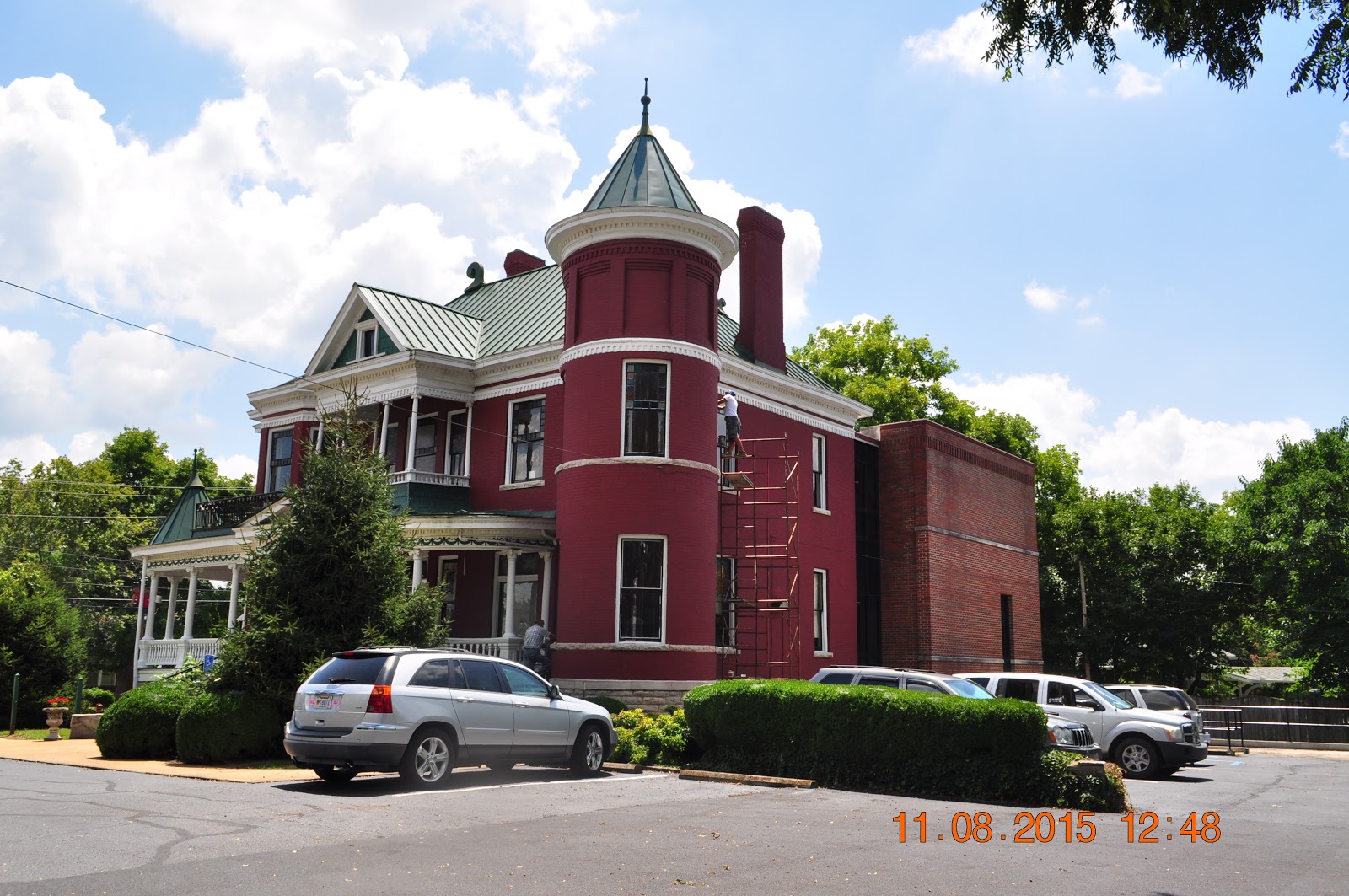
We saw the Thomas Martin House, now a bank.
CSB  Bank is located inside this beautiful old home, which is being repaired

Hubert & Grace Grissom Colonial Hall College
Our next stop was the Sam Davis Memorial Museum, the site of Sam Davis' hanging, located in the Sam Davis Avenue Historic District.
Sam Davis Avenue Historic District 
Tracing the original eastern city boundary and the Congressional Reservation Line, once dividing white and Indian territory, Sam Davis Avenue is named for a Confederate hero hanged by the Federals on this hill in 1863. The Historical District, placed on the National Register in 1989, contains outstanding architecture of the 1860~1910 period.
The Sam Davis Memorial Museum, where Sam Davis was hanged
Born October 6, 1842, near Smyra, Rutherford County, TN, though a Confederate Soldier in the line of duty, he was executed as a spy by the Federals at Pulaski, November 27, 1863
Had I a thousand lives to live 
Had I a thousand lives to give
I'd give them Nay
I'd gladly die
Before I'd live 
One Life a Lie 
Sam Davis's home, grave, and Museum are located in Smyrna, Tennessee. 
Sam Davis was buried near the family home, supposedly in a flowerbed, on Christmas Eve.
Coke Cola Building


PulaskiTN 38478 
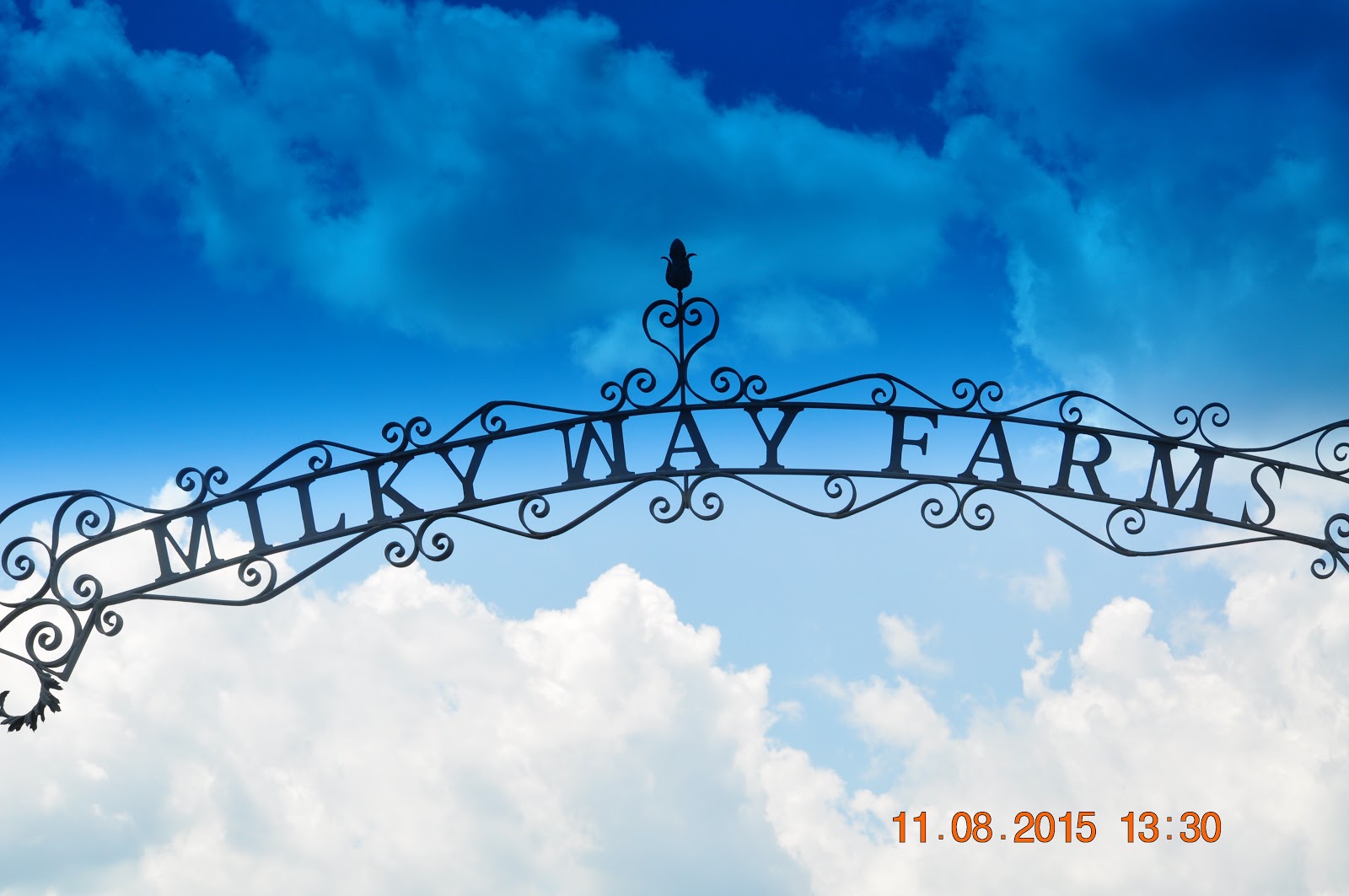
Our next stop was the Milky Way Farms owned by Charles Jones and his daughter, Lynn Golden.
The home and farm are now used to host weddings, events, festivals, tours, guided hunting activities, and other seasonal activities.
Milky Way Farms Gates

Milky Way Farms
The farm began in 1931 when Frank Mars, the founder of the Mars Candy Company, purchased land in Tennessee. It was during a period of severe economic hardship in Giles County, and many people were losing their homes. Mr. Mars bought up the land, let the people stay in their homes, and had them work for him.
His farm employed hundreds of workers from the Giles County Area. Mr Mars had prized Herefords, the fastest horses, fine sheep, incredible barns, and a fantastic view for his house set atop a hill overlooking the valley below.

Milky Way Farms

Milky Way Farms Manor House 
The original dining room table measures 12' x 28' and can seat up to 40 people.
Fountain
  • In 1930-31, Frank Mars acquired 2,805 acres of land in Giles County.
  • In 1931, Frank Mars built the original home clubhouse, which burned down within a few months.
  • In 1931-32, Frank Mars rebuilt the Manor House as it stands today out of stone from his 2,800-acre estate (25,000 square feet, 20 bedrooms, 14 baths, and two ½ baths)
  • In 1931-34, a total of 30 barns, 70 cottages, a Mausoleum, and the world-famous "crooked sheep barn" were built.
  • In 1931-34, as many as 935 local hired hands were working for $.50 a day at Milky Way Farm.
  • In 1932, Frank Mars introduced the Three Musketeer candy bar
  • In 1932, Frank designed and built the Milky Way race track, where many champion thoroughbreds were trained including the 1940 Kentucky Derby Winner, Gallahadion
  • In 1931-34, Milky Way Farm was home to five nationally known livestock operations: Hereford cattle, thoroughbred horses, commercial dairy, beef cattle, and Hampshire sheep
  • The dining room table measures 12' x 28' and can seat up to 40 people.
We watched a five-minute video about the farm, we asked a few questions, and then we were told we could tour the whole house except the kitchen, where the curator was cooking.

The curator had a pot of green beans cooking in the kitchen for a large group arriving later that day. Boy, did they smell good! They have weddings & entertain large groups.
Staircase in Manor 

Staircase in Manor 

One of the twenty Bedrooms in the manor 

Fireplace in the Master Bedroom 

One of the twenty Bedrooms in the manor

Fireplace in the Living Room 

A lot of the farm has been sold, and most of the rest of it. The roads are not very good, so we did not venture any further.

We were going to try out the Bar BQ Restaurant between Athens and Rogersville, but it is not open on Mondays and Tuesdays. 
We picked up the van from Champion Chrysler after having the back seat fixed, so it will fit well in the storage and can be raised back into a sitting position.
We drove to Stanfield's in Rogersville, and my husband ordered a New York Strip, baked potato, and salad bar. I ordered the kids a three-piece shrimp plate with coleslaw and two hushpuppies.
Another hot day adventure, but most of what we did was inside. 
The clouds were beautiful today.

Monday, August 10, 2015

2009 ~Sunday Aug 23, Lawrence County Alabama Historical Markers

We started out in Courtland, taking pictures —first the Harris Simpson. Most of the other markers were in or near the city park.

This circa 1820 house is thought to be one of the oldest houses in Courtland. Occupying a lot platted by the Courtland Land Company in 1818, the house faces North toward what was once the main Tuscumbia Road. Dr. Jack Shackelford (1790-1857), an early settler and legislator, is believed to have lived in this house in the mid-1800s. After a nearby Civil War skirmish, the house served as a military hospital. In 1895, Mrs. Susan Jackson Harris, granddaughter of James Jackson of the famous Forks of Cypress Plantation near Florence and wife of John Hunter Harris of Rosemont Plantation, acquired the house. Her daughter, Caroline Harris Simpson, lived here until 19,72, and her descendants owned the house until 1995. In 2,001, the Alabama Preservation Alliance purchased and placed a protective easement on the property, which required all future owners to preserve the house and grounds.

This is a good example of the early American "I" house, so called for its tall, narrow side profile. The original part of the house is two stories, with two large rooms and a central hall on both floors. The braced-frame construction, a framing system that uses corner posts and bracing, is covered with beaded siding. Delicate Federal-period mantelpieces, molded trim, chair rails, and a paneled staircase grace the interior. Traces of faux~bois, a decorative painting technique popular in the 19th century, also survive. An unusual feature is the shed-roofed "chimney pent" (or closet) abutting the west chimney. Side and rear additions were added in the early 1900s.


The Town of Courtland 1819
Federal lands in this area were first sold in 1818 and quickly purchased by settlers and speculators. A group of investors calling themselves the "Courtland Land Company," consisting of William H. Whitaker, James M. Camp, William F. Broadnax, John M. Tifford, Benjamin Thomas, and Bernard McKiernan, acquired the future town site and had it laid out in a gridiron street pattern containing 300 lots. These were put up for sale immediately. In hopes that Courtland would become the county seat, the present square was set aside for a courthouse. Alabama's territorial legislature incorporated Courtland on December 13, 1819.

Major Lewis Dillahunty and his wife, Lucinda, reputedly settled at Courtland in 1816. Dillahunty, a surveyor, had fought with Andrew Jackson at New Orleans. Soon afterward, wealthy planters, with their families and slaves, arrived from Virginia, Tennessee, the Carolinas, and Georgia. They were joined by merchants, artisans, lawyers, doctors, preachers, and innkeepers as Courtland became the trade center for the surrounding farms and plantations. The Courtland Herald, a newspaper, was established in the 1820s. For most of its history, Courtland's population has ranged between 400 and 700.

Courtland's Early Architecture
Courtland's Early Architecture During the early 1800s, an assortment of wooden, brick, and log business structures surrounded the town square. Most of the old buildings on the square today (on the North and east sides) date from the late 1800s and early 1900s. The fronts of some of them feature characteristic Victorian detailing. At the northeast corner of the square are four 19th-century stone mounting blocks placed for the convenience of horseback riders. The tall red cedars seen throughout Courtland and along the streets radiating from the square have been a feature of the landscape since the early days. 

Courtland's Early Architecture 1820-1940
Courtland's Early Architecture: Structures within the Courtland historic district represent over 150 years of changing tastes in building design. Although only a few of Courtland's earliest buildings survive, the Federal-style architecture of the oldest houses suggests the community's strong original ties to Virginia and other upper South states. Typical early residences, whether frame or brick, feature a gable roof with tall chimneys at each end. Sometimes, weatherboarding conceals log walls underneath. Many buildings dating from the 1850s through the 1930s reflect Italianate, Victorian, and neoclassical architectural influences. There are also early 20th-century "bungalows", some built of native sandstone. Courtland still counts about twenty buildings predating the Civil War (1861). 


The African ~ American Experience
African Americans played a very significant role in the early history of Courtland. Most came as slaves from the older southern states to help clear the land, plant cotton and corn, and serve as household domestics. President Thomas Jefferson's great-grandson, William S. Bankhead, brought his personal servant and valet, Jupiter, from Monticello when he settled near Courtland in the 1840s. Skilled slave craftsmen also assisted in the construction of many Courtland buildings before the Civil War. After emancipation, most African Americans earned their livelihood as tenants and small farmers. 


The African ~ American Experience
Before being officially denied political participation by the state constitution of 1901, Courtland's African-American community produced the most successful local Republican party organization in North Alabama, on occasion uniting with area whites to create a biracial government. H. H. Stewart, a graduate of Williams College (Mass.), was an outstanding educational and political leader of the Courtland black community during this period. In the early 20th century, many Courtland-area African Americans migrated to the North and the Upper Midwest to seek greater economic and social opportunities.


The Red Rovers / Red Rovers Roster
A volunteer military company was organized at Courtland in 1835 to aid Texas in its struggle for independence. Commanded by Dr. Jack Shackelford, a local physician, the company derived its name from the color of the homespun uniforms made by citizens of Courtland. In the first battle, Rovers were assigned to the regiment cut off, captured at Coleta, March 20, 1836. Surrendered on promise of return to U. S. On March 27, company and others, 365 men, executed at Goliad by order of Gen. Santa Anna. Shackelford and seven other Rovers were spared. He later escaped and returned to Courtland. The Goliad incident, along with the Alamo, rallied U.S. support and guaranteed Texas's freedom.


The Red Rovers / Red Rovers Roster

* Capt. J. Shackelford • * Lt. Wm. C. Francis •Sgt. F. G. Shackelford • Sgt. A. J. Foley • * Sgt. J. D. Hamilton • Sgt. J. D. Hamilton • Sgt. C. M. Short • Cpl. J. H. Barkley • Cpl. H. H. Bentley • Cpl. David Moore • Cpl. Andrew Winter • Patrick H. Anderson • John N. Barnhill • Joseph Blackwell • * George W. Brooks • * L. M. Brooks • T. E. Burbridge • F. T. Burt • J. W. Cain • Thomas Cantwell • Seth Clark • John G. Coe • * D. Cooper • Harvey Cox • R. T. Davidson • George L. Davis • H. C. Day • A. Dickson • Alfred Dorsey • H. L. Douglas • W. C. Douglas • James E. Ellis • Samuel Farley • * Joseph Fenner • Robert Fenner • J. G. Ferguson • E. B. Franklin • D. Gamble M. C. Garner • J. E. Grimes • William Gunter • William Hemphill • John Hyser • John Jackson • John N. Jackson • H. W. Jones • Charles McKinley • John H. Miller • D. A. Murdock • William Quinn • W. F. Saavage • J. N. Seaton • W. S. Shackelford • * Wilson Simpson • B. Strunk • James Vaughan • Wm. E. Vaughan • James S. Wilder • Robert W. Wilson* Escaped at execution, on patrol, or on leave when the unit was captured.  

Early Roads
Tennessee Street along the north side of the square was originally part of Gaines' Trace, a horse path laid out in 1807 under the direction of Capt. Edmund Pendleton Gaines of the U. S. Army. From Melton's Bluff on the Tennessee River, the trace ran westward to Cotton Gin Port on the Tombigbee, in present-day Mississippi. Another crucial early thoroughfare was the Byler Road (1819), which ran southward through Courtland and linked the Tennessee Valley to Tuscaloosa and lower Alabama. 


One of the South's First Railroads, 1832
Seeking a means to ship cotton and other goods around the treacherous Muscle Shoals of the Tennessee River, area planters and merchants met at Courtland in 1831 to consider a rail line. On January 13, 1832, the 50-mile-long Tuscumbia, Courtland & Decatur railroad was chartered. Early trains were usually horse-drawn, although an English-made steam locomotive was acquired in 1834. Absorbed by the Memphis & Charleston line after 1850, the railway was largely destroyed during the Civil War. The rebuilt railroad became part of the Southern system in 1898.


American Legion - Post 58
On April 20, 1934, a temporary charter was issued for Gen. Joe Wheeler Post 58, Courtland, Alabama. On November 12, 1946, a permanent charter was granted, and the name was changed to Wiley Horton Post 58 in honor of the deceased son of State Department Commander C.C. Horton.

American Legion - Post 58
The American Legion is the largest veterans' organization in the United States. It seeks to advance the aims and interests of all veterans. The Legion has 16,000 local posts. Each year the American Legion sponsors over 3,000 baseball and other athletic teams, 3,600 Boy Scout Troops; also, national high school oratory contests to promote the study of the U.S. Constitution and the Bill of Rights.

2009 ~Aug 11-14 Meadow's Physical Therapy & McWane Center Birmingham, Al


Meadow at the RMH

Meadow is enjoying the water at the McWane Center.

Meadow is enjoying the water at the McWane Center.
Meadow at Dino dig at the McWane Center.
Meadow at Dino dig at the McWane Center.r
Meadow is enjoying the sand at the McWane Center.
Meadow is having physical therapy at Children's Outpatient Center PT & OT Hearing & Speech, located at 1208 3rd Avenue, Birmingham, from August 11-14.
On Tuesday, we rode to Birmingham and arrived just in time for Meadow's physical therapy at 9:00 A.M. 
We checked in at the RMH after MMeadow's appointment,
where we will be staying for the next few days. 
For lunch, we walked to Captain D's, which was just a block away.
Meadow loves to fish. 
We rode to the YMCA, where both Lora and I worked out. 
We put Meadow in Child Watch at the YMCA.
I rode the stationary bike for thirty minutes. 

Meadows' appointment on Wednesday is from 9:00–12:00 P.M.
We rode to the YMCA, after Meadows' physical therapy, where both Lora and I worked out. I rode the stationary bike for twenty-five minutes.
We put Meadow in Child Watch at the YMCA.
We rode to the mall to shop and stopped to get the tires checked on Lora's Car. 

On Thursday, Meadow had several different doctor appointments, one with Doctor Grant's cleft doctor, Nathaniel Robins's Genetic doctor, and an Otolaryngologist (ENT).
Meadow's therapy was from 3:00 to 6:00 P.M. 
We ate lunch at McDonald's. Meadow likes the chicken nuggets.
We squeezed in an hour at the McWane Center, where Meadow enjoyed playing in the sand & water.

Friday was Meadow's last day of physical therapy, which was from 9:00 to 11:00 P.M. 
Before we went to therapy, we cleaned our room, washed our clothes, and checked out of the RMH. 
After Meadow's therapy, we walked several blocks, pushing Meadow in her wheelchair, to the Fish Market, where we ate lunch. 

Lora and I split a Traditional Greek Salad with Crisp romaine and iceberg lettuce, ripe tomatoes, Salonica peppers, and green olives topped with feta cheese and Greek dressing. 

Lora and I  split a Bam Bam Group.
Fried lightly, then tossed with a sweet-and-spicy sauce. Served with Greek Roasted Potatoes.

After we finished our meal, we walked back to the car and rode home. We were home by 4:30.

Time Travel

 My thoughts have been about time moving forward and backward.  So Time travel is not something we think about. It is just something we do....